
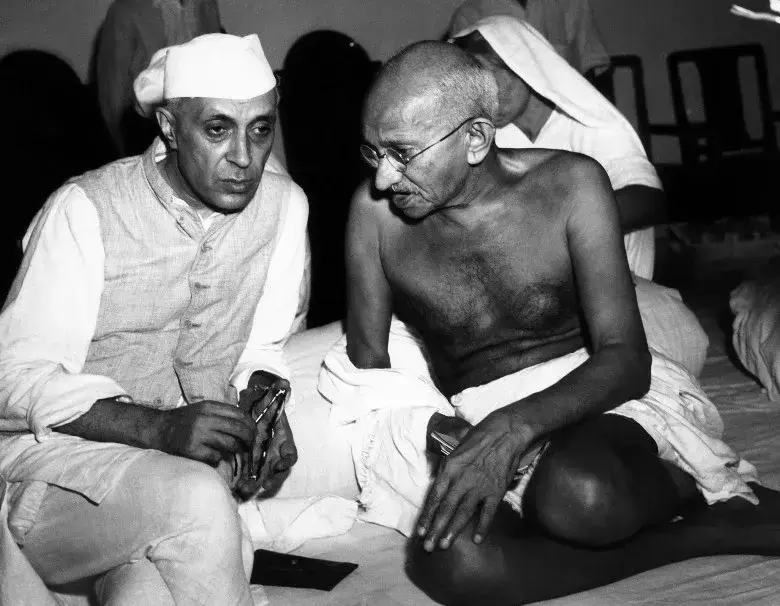
The Liberators: Lincoln's War vs. Gandhi's Peace
A profound analysis of two of history's greatest liberators. How does Abraham Lincoln's war to save a union and end slavery compare to Mahatma Gandhi's nonviolent revolution to free a nation?
History presents us with titans who break the chains of oppression, leaders whose legacies are defined by the freedom they brought to millions. Among them, two figures stand as philosophical pillars, representing two profoundly different paths to liberation: Abraham Lincoln, the president who waged a brutal war to save a nation and destroy slavery, and Mahatma Gandhi, the ascetic who orchestrated a revolution of peace to expel an empire.
Lincoln, the pragmatist, believed that the evil of slavery could only be purged by “the sword.” Gandhi, the idealist, believed that injustice could only be truly defeated by “satyagraha,” or truth-force. One was a commander-in-chief; the other, a spiritual guide. Their methods stand in stark contrast, yet their goals were the same: to forge a new, freer future for their people.
Abraham Lincoln: Emancipation Through Fire
When Abraham Lincoln became president of the United States, he faced the ultimate crisis: a nation tearing itself apart. His primary goal was preservation, but the moral cancer of slavery forced his hand. He learned that to save the union, he had to cleanse it.
The Necessity of the Sword
Lincoln was not a pacifist. He was a deeply pragmatic leader who understood that some injustices are so entrenched they cannot be persuaded; they must be defeated. He wielded the full might of the state, commanding armies in the bloodiest conflict in American history. His issuance of the Emancipation Proclamation was a masterstroke, transforming a political war into a moral crusade. For Lincoln, liberation was a grim, necessary, and violent task—a trial by fire to achieve a “new birth of freedom.”
Mahatma Gandhi: Revolution Through Peace
In the 20th century, the Indian subcontinent was the crown jewel of the British Empire, an institution of immense military and economic power. To challenge it head-on was impossible. So, Mahatma Gandhi, a British-trained lawyer, devised a new form of warfare—one without weapons.
The Power of Satyagraha
Gandhi’s strategy of nonviolent civil disobedience was a revolution of the soul. He organized boycotts of British goods, led the iconic Salt March to defy imperial taxes, and endured imprisonment and hunger strikes. He understood that the power of the British Empire rested not just on its armies, but on the cooperation of the Indian people. By withdrawing that cooperation peacefully and publicly, he exposed the moral bankruptcy of colonial rule. He demonstrated to the world that an oppressor’s authority dissolves when the oppressed refuse to fear it. His philosophy would later inspire other great leaders like Martin Luther King Jr. and Nelson Mandela.
Two Paths to Freedom
| Aspect of Liberation | Abraham Lincoln | Mahatma Gandhi |
|---|---|---|
| The Arena | The battlefield and the halls of Congress. | The public square and the court of world opinion. |
| The Weapon | The Union Army and presidential authority. | Nonviolent resistance (Satyagraha). |
| The Enemy | An internal rebellion defending slavery. | An external colonial empire. |
| The Cost | Unprecedented bloodshed and national trauma. | Immense personal sacrifice and imprisonment. |
| Core Philosophy | The pragmatic use of force for a moral end. | The moral superiority of peace over power. |
Lincoln’s great challenge was to unify a nation by force, healing it only after the battle was won. Gandhi’s challenge was to unify a nation in spirit first, making a physical battle unnecessary.
Conclusion: The Liberator’s Paradox
The legacies of Lincoln and Gandhi present a profound question: is the path of the warrior or the path of the saint more effective in the fight for freedom? The answer, perhaps, is that both are necessary.
Lincoln reminds us that some evils are so violent and absolute that they must be met with overwhelming force. He stands as a testament to the leader who is willing to bear the terrible burden of war to achieve a greater good.
Gandhi reminds us that the most powerful weapon is the human will and that true victory is not in defeating an enemy, but in converting them. He stands as proof that an idea, rooted in unshakable moral conviction, can bring the mightiest of empires to its knees.
One saved the body of his nation in a bloody war; the other saved the soul of his nation by refusing to fight one.
Discover more about the titans who shaped our world in the Pantheon of Titans or explore the philosophical currents that drove them in the Library of Concepts.
Continue Reading
The Art of Power: A Deep Dive into History's Most Formidable Female Rulers
From Cleopatra's diplomacy to Elizabeth I's statecraft, explore the strategies, sacrifices, and legacies of the most powerful women in history. An expert analysis of female leadership through the ages.
Read More →
The Dual Fight for Freedom: Lincoln's Law vs. Tubman's Action
A comparison of two monumental American figures in the fight against slavery: Abraham Lincoln, who used the power of the Presidency, versus Harriet Tubman, who used direct, perilous action.
Read More →
Empires of Mind vs. Matter: Tesla vs. Caesar
A unique comparison between Nikola Tesla, the visionary inventor who electrified the world, and Julius Caesar, the conqueror who forged the Roman Empire. Who built a more enduring legacy?
Read More →