
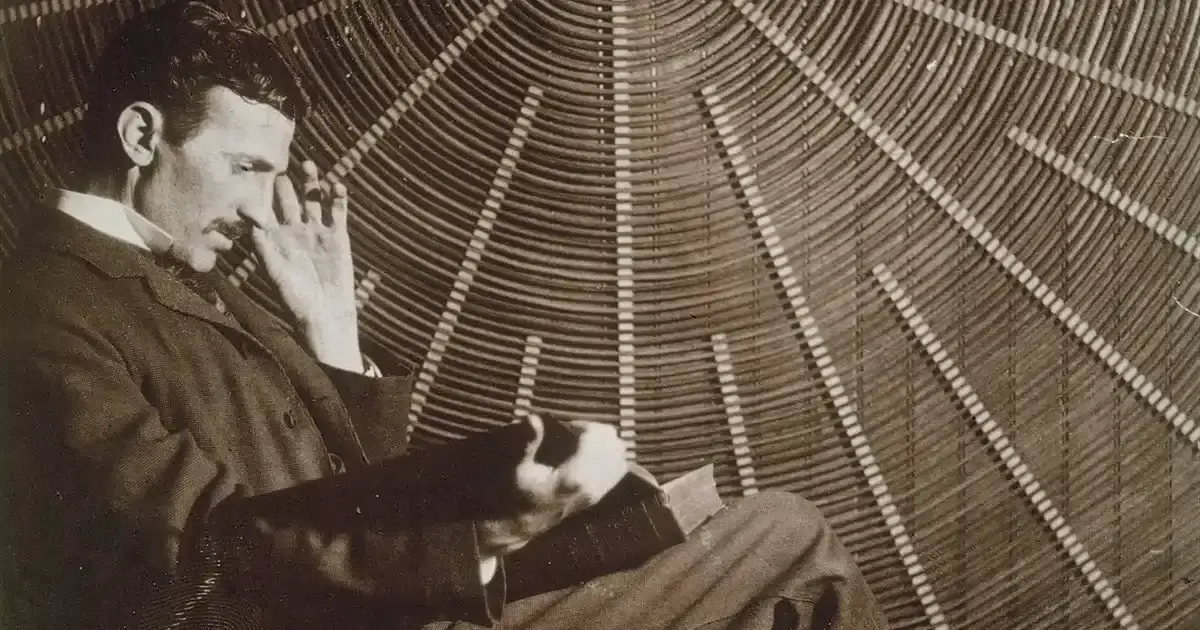
Empires of Mind vs. Matter: Tesla vs. Caesar
A unique comparison between Nikola Tesla, the visionary inventor who electrified the world, and Julius Caesar, the conqueror who forged the Roman Empire. Who built a more enduring legacy?
What is an empire? Is it a dominion of land and people, forged by the sword and held by the law? Or is it an invisible kingdom of ideas, built in the laboratory and woven into the very fabric of civilization? History offers us two perfect architects of these opposing empires: Julius Caesar, the Roman general who conquered the known world, and Nikola Tesla, the inventor who envisioned and engineered our electric future.
One mastered the world of matter—of legions, logistics, and political power. The other mastered the world of the mind—of frequencies, energy, and technological prophecy. This is an analysis of two titans who, separated by two millennia, demonstrate that the ambition to reshape the world is not confined to the battlefield.
Julius Caesar: The Architect of a Physical Empire
In the 1st century BC, Julius Caesar inherited the formidable war machine of the Roman Republic and perfected it. His genius was not just in winning battles, but in understanding that lasting power was built on infrastructure, loyalty, and ruthless efficiency.
Conquest Through Pragmatism
Caesar’s campaigns in Gaul were a masterclass in turning chaos into order. He was a brilliant strategist, but also a master engineer and logistician. He didn’t just defeat his enemies; he assimilated them, binding them to Rome with roads, laws, and the promise of citizenship. His empire was tangible, a physical entity etched onto the map with the blood and concrete of his legions. He understood that to control the world, you had to physically occupy it.
Nikola Tesla: The Architect of a Technological Empire
In the late 19th and early 20th centuries, Nikola Tesla waged a different kind of war: the “War of the Currents.” He saw a future that others could not, a world powered by the elegant and efficient system of Alternating Current (AC).
Conquest Through Vision
Tesla’s weapons were not swords, but coils, turbines, and the sheer power of his intellect. His victory over Edison’s Direct Current was not just a technical achievement; it was the conquest of a paradigm. He didn’t build roads of stone, but invisible highways of electricity that would power the homes, factories, and cities of the entire planet. His work on radio, wireless communication, and robotics laid the foundation for the interconnected digital world we live in today. His empire is not on any map, but it is everywhere around us.
The Nature of Their Dominion
Though their methods were worlds apart, both men were driven by a desire to impose a new order on the world. Their legacies offer a profound lesson in the different forms that power can take.
| Aspect of Empire | Julius Caesar | Nikola Tesla |
|---|---|---|
| Domain of Power | The physical world of territory and politics. | The conceptual world of energy and information. |
| Primary Weapon | The Roman Legion & political acumen. | The scientific mind & radical invention. |
| Method of Control | Law, infrastructure, and military presence. | Patents, systems, and technological standards. |
| Enduring Legacy | A political and legal blueprint for the West. | The technological infrastructure of modernity. |
Caesar’s contemporary, Cicero, said, “The authority of those who teach is often an obstacle to those who want to learn.” Tesla, like Caesar, had to overcome the established “authority” of his time—be it rival inventors like Edison or the scientific dogma of the day.
Conclusion: The Empire That Never Fell
Julius Caesar built an empire of matter. It was vast, powerful, and it shaped the course of Western civilization. But like all physical empires, it eventually crumbled. Its stones and laws remain, but as relics of a bygone era.
Nikola Tesla built an empire of the mind. It is an unseen dominion of alternating current, radio waves, and the very principles that power our modern age. It has no borders, no legions, and no single seat of power. And unlike Caesar’s, Tesla’s empire has never fallen; it has only expanded, becoming more integrated into our lives with each passing day.
One gave us a model for how to rule the world. The other gave us the tools to create a new one.
See how these visionaries compare to other historical giants in The Pantheon of Titans, or create your own dream matchup in The Colosseum.
Continue Reading
The Art of Power: A Deep Dive into History's Most Formidable Female Rulers
From Cleopatra's diplomacy to Elizabeth I's statecraft, explore the strategies, sacrifices, and legacies of the most powerful women in history. An expert analysis of female leadership through the ages.
Read More →
The Dual Fight for Freedom: Lincoln's Law vs. Tubman's Action
A comparison of two monumental American figures in the fight against slavery: Abraham Lincoln, who used the power of the Presidency, versus Harriet Tubman, who used direct, perilous action.
Read More →
Conquest of Land vs. Conquest of the Future: Alexander the Great and Nikola Tesla
An epic comparison between Alexander the Great, who conquered the known world in a decade, and Nikola Tesla, who engineered the unseen empire of electricity that powers our modern age.
Read More →