
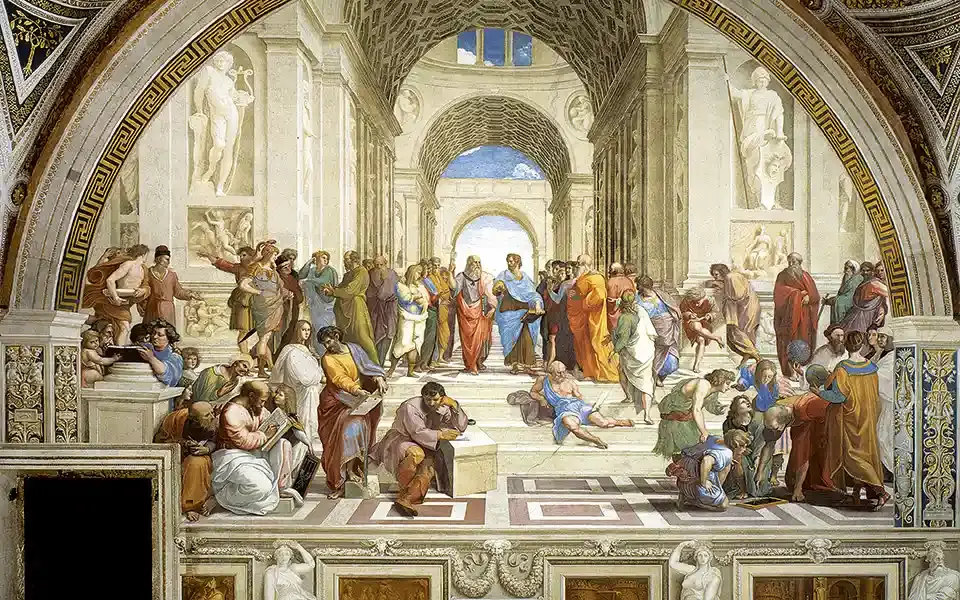
The Teacher and The Student: How Plato and Aristotle Shaped Reality
A detailed analysis of the foundational philosophical conflict between Plato and his greatest student, Aristotle. Explore their opposing views on reality, knowledge, and ethics that created the twin pillars of Western thought.
In the grand intellectual theater of Ancient Greece, no relationship was more consequential than that of Plato and his star pupil, Aristotle. For twenty years, Aristotle studied at the Academy founded by Plato, himself the devoted student of Socrates. Yet, from this shared intellectual cradle emerged two profoundly different and competing visions of reality, knowledge, and human purpose. This divergence became the single most important philosophical event in Western history, creating two streams of thought that have irrigated and shaped the landscape of our world for over two millennia.
The famous Renaissance painting, Raphael’s “School of Athens,” perfectly captures their conflict: Plato, the elder, points upward to the heavens, to a realm of abstract ideas and perfect forms. Aristotle, his student, gestures firmly down to the earth, to the tangible, observable world around us. One was an idealist who trusted reason above all; the other, an empiricist who laid the groundwork for modern science.
Plato: The World of Perfect Forms
Deeply influenced by the execution of his mentor, Socrates, Plato was disillusioned with the messy, corruptible world of Athenian politics and sensory experience. He sought a deeper, unchanging truth, a reality that was perfect and eternal. This quest led him to his most famous and influential contribution: the Theory of Forms.
Metaphysics: The Allegory of the Cave
For Plato, the world we perceive through our senses is not the real world. It is a mere shadow, an imperfect and decaying copy of a higher, non-physical realm of pure ideas, which he called the World of Forms. The famous “Allegory of the Cave” illustrates this perfectly: we are like prisoners chained in a cave, watching shadows flicker on a wall, mistaking them for reality. The philosopher’s task is to break free from these chains, ascend into the light, and directly perceive the Forms themselves—the perfect essence of Justice, Beauty, and Goodness.
This means that true knowledge, for Plato, is not discovered through observation, which can be deceptive. It is recollected through intense rational thought and dialogue—a process of the soul remembering the perfect Forms it knew before it was trapped in a physical body.
Aristotle: The World of Observable Reality
While a brilliant student, Aristotle could not accept his master’s dualistic reality. For twenty years, he listened, learned, and ultimately, dissented. He believed that to understand reality, one did not need to look to another world, but to look more closely at this one.
Metaphysics: Form and Matter in the Natural World
Aristotle famously rejected the independent World of Forms. He argued that the “form” or essence of a thing was not in some heavenly realm, but within the object itself. A horse is a horse because it contains the form of “horseness” combined with its physical matter. To understand the world, we must study the tangible things in it.
This led him to become a great biologist and categorizer. He developed a sophisticated system for understanding any object or being through its Four Causes: the Material Cause (what it’s made of), the Formal Cause (its essence or design), the Efficient Cause (what brought it into being), and the Final Cause (its ultimate purpose, or telos). This systematic approach to understanding the natural world was the true beginning of the scientific method. For Aristotle, knowledge begins with the senses. We observe particulars—this tree, that dog—and from them, using logic and reason, we derive universal principles.
The Great Divergence: A Comparative Analysis
Their differences extended from the nature of reality to the purpose of human life, creating a foundational split in Western thought.
| Philosophical Area | Plato’s Idealism | Aristotle’s Empiricism |
|---|---|---|
| View of Reality | A dualistic world: the imperfect physical realm and the perfect, eternal realm of Forms. | A single, unified reality: the natural world, where form and matter are inseparable. |
| Path to Knowledge | Through pure reason and intellectual contemplation to “recollect” the Forms. | Through sensory observation and logical induction, starting with the particular to understand the universal. |
| Focus of Ethics | Achieving virtue by understanding the “Form of the Good,” an abstract and perfect ideal. | Achieving Eudaimonia (flourishing) through practical wisdom and finding the “Golden Mean” in action. |
| Ideal State | A rigid hierarchy ruled by philosopher-kings who have perceived the Forms. | A constitutional government (a polity) that balances the interests of the rich and poor. |
| Lasting Influence | Foundational for rationalism, Christian theology, and abstract idealism. | Foundational for the scientific method, logic, biology, and political science. |
Even their most famous students reflect their philosophies: Aristotle would go on to tutor a young Alexander the Great, instilling in him a respect for science, observation, and the practicalities of ruling a vast, physical empire.
Conclusion: The Twin Pillars of Western Thought
The philosophical “duel” between Plato and Aristotle was not about a winner and a loser. It was about the creation of the essential tension that has driven Western intellectual history. It is the tension between the idealist and the pragmatist, the mathematician and the biologist, the rationalist and the empiricist.
Plato gave us our dreams of perfection, our belief in timeless ideals, and our drive to understand the abstract principles that govern the universe. Aristotle gave us our tools for understanding the world as it is, our respect for evidence, our systems of logic, and our focus on living a good life in the here and now.
Every philosopher, scientist, artist, and political thinker since has, in some way, walked in their footsteps, either by siding with one or by attempting to build a bridge between the two worlds they defined. They are the teacher and the student who, through their brilliant disagreement, gave us the twin pillars upon which all of Western thought rests.
Continue Reading
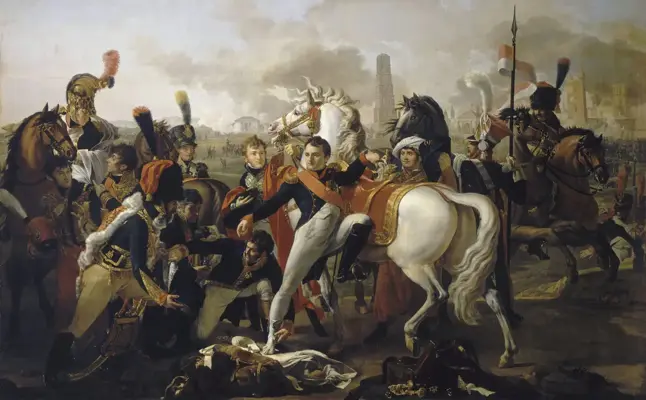
The Great Strategists: A Definitive Comparison of Napoleon, Caesar, and Alexander
A deep-dive analysis into the military tactics, battlefield innovations, and lasting legacies of Napoleon Bonaparte, Julius Caesar, and Alexander the Great. Who was the ultimate commander?
Read More →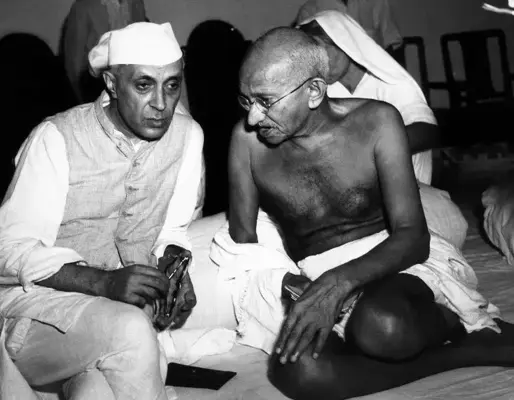
The Liberators: Lincoln's War vs. Gandhi's Peace
A profound analysis of two of history's greatest liberators. How does Abraham Lincoln's war to save a union and end slavery compare to Mahatma Gandhi's nonviolent revolution to free a nation?
Read More →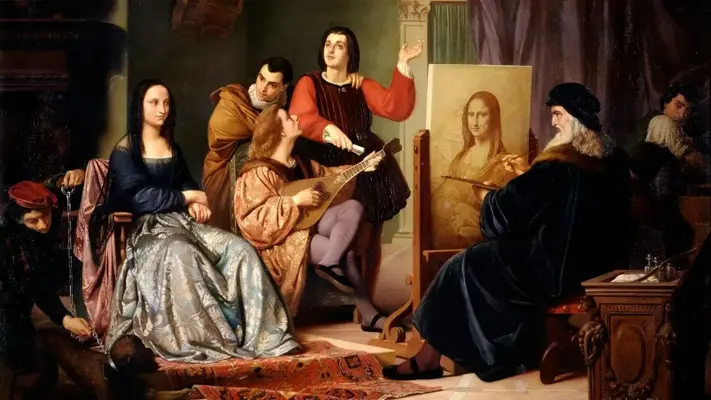
Clash of Ideas: The Renaissance vs. The Enlightenment
A detailed comparison between two of the most transformative periods in Western history. Discover the core ideas, key figures, and lasting impact of the Renaissance and the Enlightenment.
Read More →