
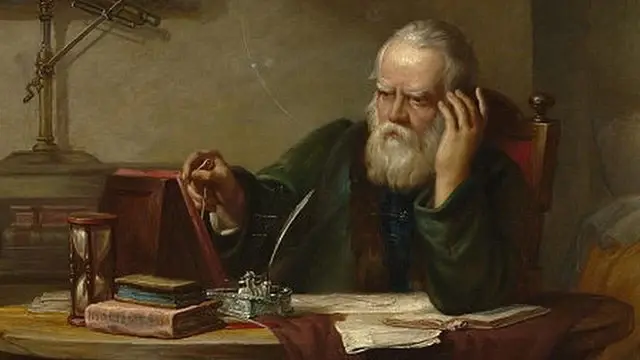
Rebels of Reality: Galileo vs. Marie Curie
A compelling analysis of two scientific pioneers who challenged the orthodoxies of their eras. Discover the parallels between Galileo's fight for heliocentrism and Marie Curie's breakthrough in a male-dominated world.
The history of science is a story of rebellion. It is a narrative of courageous minds who dared to question the established order, often at great personal cost. Two figures, separated by nearly three centuries, perfectly embody this spirit of revolutionary inquiry: Galileo Galilei, who pointed his telescope to the heavens and shattered an ancient cosmology, and Marie Curie, who peered into the heart of the atom and unveiled a new, mysterious source of power.
Both were pioneers who ventured into uncharted territory. Both faced immense resistance from the establishments of their day. And both fundamentally altered our understanding of the universe.
Galileo Galilei: The Starry Messenger vs. The Status Quo
In the early 17th century, the Western world’s view of the cosmos was firmly rooted in the teachings of Aristotle and the church: a geocentric model where the sun, moon, and stars revolved around a stationary Earth. It was a model that was not just scientific, but deeply theological.
The Telescope as a Weapon
Galileo did not invent the telescope, but he was the first to systematically use it to challenge this ancient worldview. His observations were revolutionary: he discovered the moons of Jupiter (proving that not everything orbited the Earth), the phases of Venus (which only made sense in a sun-centered system), and the craters of the moon (shattering the idea of perfect, celestial orbs). These weren’t theories; they were observable facts. His support for the heliocentric model brought him into direct, infamous conflict with the Catholic Church, culminating in his trial and house arrest for heresy.
Marie Curie: A Titan in a Man’s World
In the late 19th and early 20th centuries, the world of science was a rigid patriarchy. The atom was considered the indivisible, fundamental building block of the universe, a concept settled since the ancient Greeks. Marie Curie, a Polish immigrant in Paris, would challenge both of these orthodoxies.
Unlocking the Atom’s Secrets
Working alongside her husband Pierre, Curie investigated the mysterious rays emitted by uranium, coining the term “radioactivity.” Her painstaking research led to the discovery of two new elements, polonium and radium, and revealed that the atom was not, in fact, indivisible. It was a dynamic, unstable entity that could release immense energy. She faced constant skepticism and discrimination from a scientific community that was unaccustomed to female genius. Despite this, she became the first woman to win a Nobel Prize and the only person in history to win Nobels in two different scientific fields (Physics and Chemistry), solidifying her place in the pantheon of scientific giants like Isaac Newton and Albert Einstein.
A Rebellion of Two Kinds
Though their fields and eras were different, the core of their struggles was the same: a fight for the acceptance of empirical evidence against entrenched belief.
| Aspect of Rebellion | Galileo Galilei | Marie Curie |
|---|---|---|
| The Opposing Force | The Church & academic tradition. | The scientific patriarchy & established physics. |
| The Revolutionary Tool | The telescope. | The electrometer & chemical analysis. |
| The Heretical Idea | The Earth is not the center of the universe. | The atom is not fundamental or stable. |
| The Personal Cost | Trial, condemnation, and house arrest. | Lifelong health problems from radiation exposure. |
Galileo’s rebellion was against a theological worldview that placed humanity at the center of God’s creation. Curie’s was against a scientific worldview that assumed a simple, clockwork universe and a social order that excluded women from its highest ranks.
Conclusion: The Unstoppable Force of Evidence
The stories of Galileo and Curie are powerful reminders that scientific progress is rarely a straight line. It is a struggle, often waged by individuals against the inertia of tradition and dogma. Galileo’s ordeal taught us that a scientific truth will eventually prevail, no matter how powerful the institution that denies it. Marie Curie’s life proved that genius knows no gender and that the universe holds secrets far stranger and more wonderful than we can imagine.
They were rebels not for the sake of rebellion, but for the sake of truth. Their courage to follow the evidence, wherever it led, blazed a trail for every scientist who came after them.
Learn more about the eras that shaped these thinkers on our Interactive Timeline, or see how they compare to other visionaries in The Colosseum.