
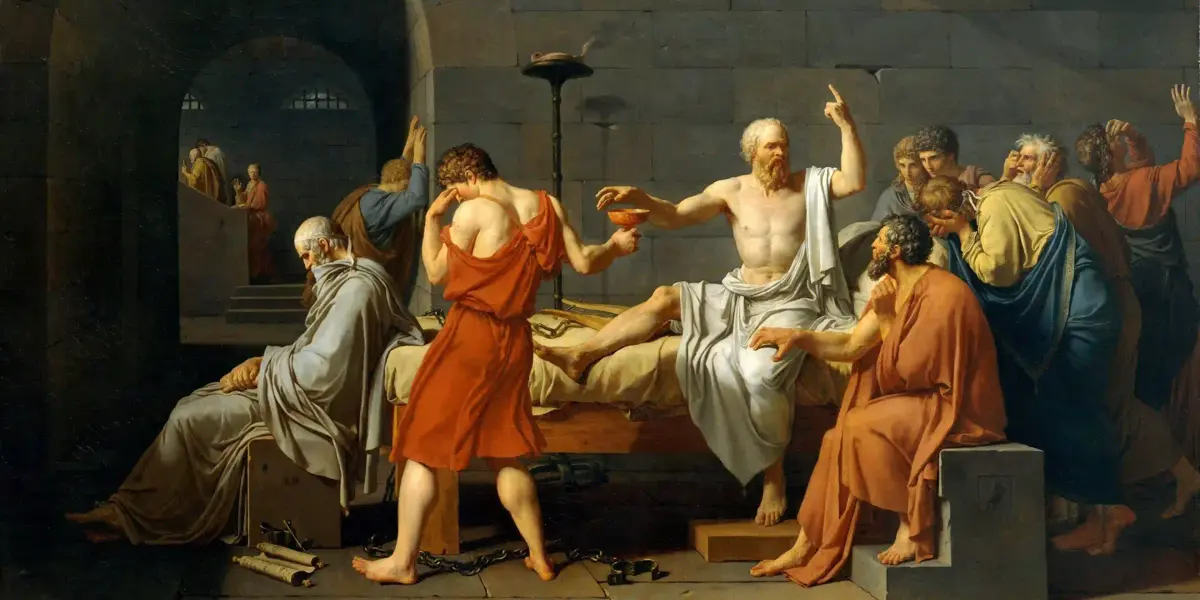
The Quest for Virtue: Socrates vs. Confucius
An analysis of two of history's greatest moral philosophers. How did the Socratic method of the West compare to the harmonious society envisioned by the East?
In the history of human thought, few figures loom as large as Socrates in the West and Confucius in the East. Separated by thousands of miles and with no knowledge of one another, they both embarked on the same fundamental quest: to define the nature of a virtuous life and a just society. Yet their methods and conclusions reveal the deep philosophical currents that would come to define their respective civilizations.
One sought truth through the relentless questioning of the individual; the other, through the order and harmony of the community. This is the clash of two titans of moral philosophy.
Socrates: The Gadfly of Athens and the Inner Virtue
For Socrates, philosophy was not found in ancient scrolls but in the agora, in face-to-face dialogue with his fellow citizens. He left behind no writings, believing that knowledge was a living, dynamic process, drawn out from within each person.
The Socratic Method: Knowledge Through Doubt
Socrates’s primary weapon was the Socratic Method, a relentless form of dialogue where, through a series of questions, he would reveal the contradictions and ignorance in his interlocutors’ beliefs. His famous motto, “The only thing I know is that I know nothing,” was not a statement of nihilism, but the essential starting point for true wisdom. For him, virtue was knowledge. He believed that no one does wrong willingly, but only out of ignorance of what is good. Therefore, self-examination was the path to moral excellence—a journey each individual had to undertake for themselves. His influence would endure through his students, like the great Plato.
Confucius: The Great Sage and Social Harmony
On the other side of the world, Confucius observed the chaos of the warring states in ancient China and came to a different conclusion. For him, virtue was not a purely individual affair but the bedrock of a stable and harmonious society.
The Path of the Junzi: Order Through Ritual and Filial Piety
The philosophy of Confucianism is centered on human relationships and ethical conduct within a social structure. He taught that the ideal society is built upon the foundation of five key relationships (ruler-subject, father-son, husband-wife, older brother-younger brother, and friend-friend), each with its own responsibilities. Concepts like Ren (benevolence), Yi (righteousness), and above all, Li (ritual or propriety) were essential. Li was not just empty ceremony but the external framework that guided correct behavior and cultivated inner virtue. The goal was to become a Junzi, a “gentleman” or “exemplary person,” whose moral conduct inspired order all around them.
A Clash of Philosophies: The Individual vs. The Community
| Key Aspect | Socrates (The West) | Confucius (The East) |
|---|---|---|
| Primary Focus | The individual and self-knowledge. | The community and social harmony. |
| Method | Dialectical questioning (Elenchus). | Study, ritual, and moral precepts. |
| Source of Virtue | Inner knowledge (“Know thyself”). | Correct social relationships and filial piety. |
| Ultimate Goal | To achieve personal moral excellence (Areté). | To create a just and orderly society. |
While Socrates’s legacy gave rise to a Western tradition that prizes skepticism, individual reason, and debate, Confucius’s created a civilization that values respect, tradition, and the collective good.
Conclusion: Two Paths to the Same End
Though their paths were radically different, both Socrates and Confucius shared an unwavering belief that morality and virtue were not divine gifts but the result of conscious human effort. One sought truth by stripping the individual of their false certainties, while the other sought to build it through a web of social responsibilities.
Both were radical reformers who believed that improving the world began with improving the self. Their dialogue, across the centuries, continues to define the fundamental debate about how we ought to live.
Explore other great thinkers in our Pantheon of Titans, or delve deeper into the ideas that shaped our world in the Library of Concepts.
Continue Reading
Empires of Mind vs. Matter: Tesla vs. Caesar
A unique comparison between Nikola Tesla, the visionary inventor who electrified the world, and Julius Caesar, the conqueror who forged the Roman Empire. Who built a more enduring legacy?
Read More →
Conquest of Land vs. Conquest of the Future: Alexander the Great and Nikola Tesla
An epic comparison between Alexander the Great, who conquered the known world in a decade, and Nikola Tesla, who engineered the unseen empire of electricity that powers our modern age.
Read More →
The Great Strategists: A Definitive Comparison of Napoleon, Caesar, and Alexander
A deep-dive analysis into the military tactics, battlefield innovations, and lasting legacies of Napoleon Bonaparte, Julius Caesar, and Alexander the Great. Who was the ultimate commander?
Read More →