
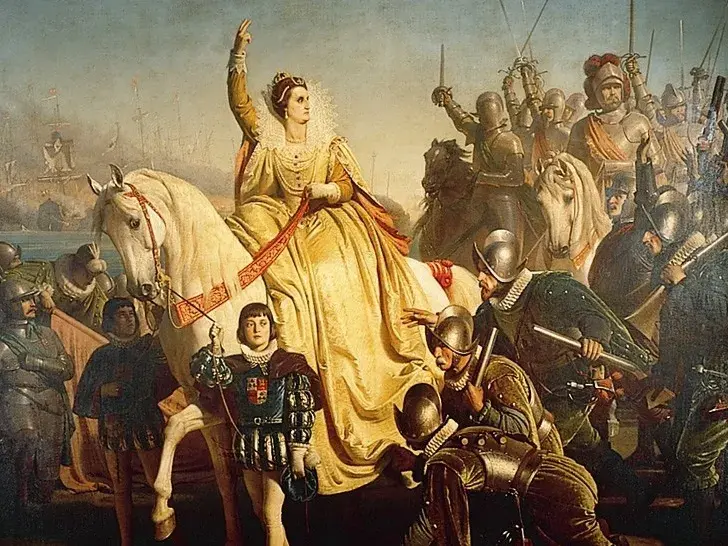
The Queen vs. The Empress: Elizabeth I and Catherine the Great
An analysis of two of history's most powerful female monarchs. We compare the shrewd statecraft of England's Virgin Queen with the enlightened ambition of Russia's Great Empress.
In the grand theater of European history, the narrative of power has often been dominated by kings and emperors. Yet, some of its most decisive and brilliant acts were directed by women who ascended to the throne against all odds and ruled with an authority that defined their age. Two of the most remarkable are Queen Elizabeth I of England and Catherine the Great, Empress of Russia.
Both inherited precarious crowns in deeply patriarchal worlds. Both faced threats of conspiracy and foreign invasion. Yet, they not only survived—they thrived, transforming their nations into formidable powers. Their reigns, however, offer a masterclass in two very different styles of female leadership: one of calculated survival and national cultivation, the other of ruthless expansion and intellectual branding.
Elizabeth I: The Art of Strategic Survival
When Elizabeth took the throne of Tudor England, she was a young Protestant queen in a nation fractured by religious turmoil and eyed greedily by the Catholic superpowers of Europe. Her entire reign was a tightrope walk, and her primary tool was not the sword, but her sharp political mind.
The Power of Indecision
Elizabeth’s greatest weapon was her legendary ambiguity, particularly regarding her marriage prospects. For decades, she masterfully played the courts of Europe against each other, using the promise of her hand to forge temporary alliances and neutralize threats without ever ceding her authority to a foreign prince. By remaining the “Virgin Queen,” she made herself the sole embodiment of England’s sovereignty. This shrewd statecraft, combined with her inspiring leadership during the Spanish Armada crisis, helped forge a powerful new English identity and a golden age of culture, graced by figures like William Shakespeare.
Catherine the Great: Power Through Will and Wit
Over a century later, a German princess named Sophia arrived in Russia as a political pawn, destined to be the wife of an incompetent heir. But through sheer force of will, she orchestrated a coup d’état, overthrew her husband, and rebranded herself as Catherine, Empress of all Russia. Where Elizabeth’s rule was defined by caution, Catherine’s was defined by audacious action.
The Enlightened Autocrat
Catherine was a ruler of contradictions. She was a devotee of The Enlightenment, corresponding with philosophers like Voltaire and championing herself as a progressive, benevolent monarch. She reformed laws and was a great patron of the arts. Yet, this intellectual veneer masked a core of iron. She ruled as an absolute autocrat, ruthlessly crushing dissent and dramatically expanding the Russian Empire through military conquest, most notably at the expense of the Ottoman Empire and Poland. She demonstrated that enlightened ideals could be a powerful tool for projecting soft power while simultaneously pursuing hard, imperial ambitions.
Two Monarchs, Two Masterclasses in Power
| Leadership Aspect | Queen Elizabeth I | Catherine the Great |
|---|---|---|
| Path to the Throne | Legitimate inheritance after a perilous youth. | A bold and bloodless coup d’état. |
| Primary Challenge | Religious division and external threats. | Internal legitimacy and a need for modernization. |
| Style of Rule | Cautious, defensive, and politically ambiguous. | Aggressive, expansionist, and intellectually branded. |
| Source of Power | The cult of personality and national unity. | Absolute authority and military might. |
| Lasting Legacy | A stable, confident England and a cultural golden age. | A vastly expanded and modernized Russian Empire. |
Elizabeth’s genius was in making a virtue of her perceived weaknesses, turning her gender and her kingdom’s isolation into her greatest strengths. Catherine’s genius was in recognizing the power of ideas, using the language of the Enlightenment to justify and solidify her absolute control.
Conclusion: A Legacy Carved in Iron and Wit
Elizabeth I and Catherine the Great were more than just queens; they were political masterminds who fundamentally shaped the destinies of their nations. Elizabeth secured her kingdom’s future through patience and shrewd defensiveness, proving that survival itself is a form of victory. Catherine seized an empire and dragged it onto the world stage, proving that ambition, backed by intellect, is a force that can redraw maps.
Together, they stand as enduring testaments to the fact that in the game of thrones, the sharpest mind is always the most potent weapon.
Explore the lives of other monumental leaders in our Pantheon of Titans or see how they clash in our Duels section.
Continue Reading
The Art of Power: A Deep Dive into History's Most Formidable Female Rulers
From Cleopatra's diplomacy to Elizabeth I's statecraft, explore the strategies, sacrifices, and legacies of the most powerful women in history. An expert analysis of female leadership through the ages.
Read More →
The Dual Fight for Freedom: Lincoln's Law vs. Tubman's Action
A comparison of two monumental American figures in the fight against slavery: Abraham Lincoln, who used the power of the Presidency, versus Harriet Tubman, who used direct, perilous action.
Read More →
Empires of Mind vs. Matter: Tesla vs. Caesar
A unique comparison between Nikola Tesla, the visionary inventor who electrified the world, and Julius Caesar, the conqueror who forged the Roman Empire. Who built a more enduring legacy?
Read More →