
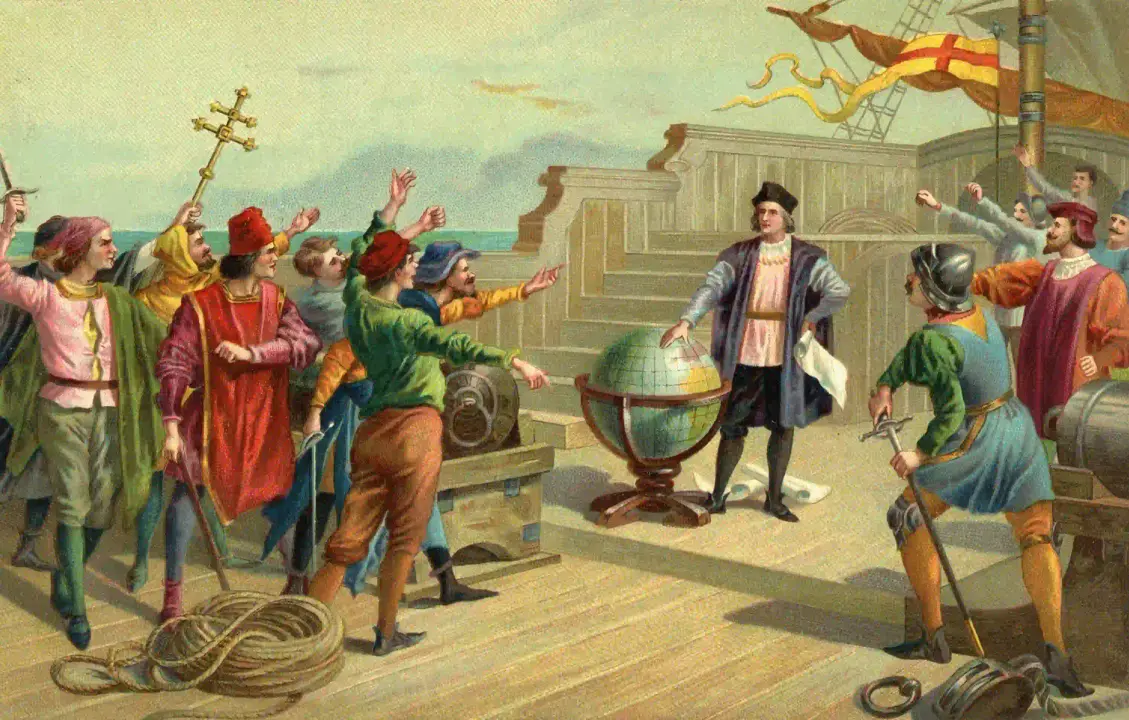
Clash of Frontiers: Suleiman's Law vs. Columbus's Horizon
A comparison of two contemporaries who ruled different spheres of the Renaissance world. Suleiman the Lawgiver dominated the East, while Columbus the Navigator expanded the West's very definition of the globe.
The Renaissance was an era of unprecedented ambition, defined by the belief that humanity could conquer any challenge, be it artistic, military, or geographical. While the Italian city-states celebrated a rebirth of classical culture, true power was being forged on two dynamic frontiers: the sea, led by intrepid explorers, and the land, commanded by magnificent emperors.
This comparison pits two contemporaries who epitomize this era of expansion: Suleiman the Magnificent, the Ottoman Sultan whose law and military might dominated the Old World; and Christopher Columbus, the navigator who, by “following the light of the sun,” irrevocably changed the global destiny of the West. One mastered the map; the other broke it.
Suleiman the Magnificent: Mastery of the Old World
Suleiman’s reign (1520 - 1566) marked the golden age of the Ottoman Empire. His ambition was not merely to maintain power, but to perfect it—militarily, culturally, and legally.
The Power of the Lawgiver
Known as “The Lawgiver” (Kanuni), Suleiman unified a vast, multi-ethnic empire with a systematic code of law that brought stability and justice. While his armies marched deep into Europe and across North Africa, his enduring legacy lay in the Kanun, the legal structure that governed taxation, land tenure, and criminal justice, ensuring that his immense empire endured. He transformed the empire into a magnificent cultural and economic rival to the fragmented Christian West.
A World Under Siege
For Christian Europe, Suleiman represented an existential threat. His power forced rulers like Queen Elizabeth I to constantly seek diplomatic and military advantages. He commanded the Mediterranean trade routes, ensuring that any new Western ventures, like those sponsored by Spain and Portugal, were driven by the need to bypass the Ottoman stranglehold.
Christopher Columbus: The Dawn of a New Horizon
Separated from Suleiman by geography and ideology, Christopher Columbus launched his pivotal voyage in 1492. His quest, though driven by a belief in a shorter route to Asia, unintentionally cracked open the geographical limits of the Old World.
Accidental Pioneer
Columbus was neither a conqueror in the mold of Suleiman nor a statesman. He was a Visionary—a dreamer whose relentless pursuit of a western passage to the Indies led to the Columbian Exchange, a pivotal event that forever linked the Americas, West Africa, and Eurasia.
The True Conquest
While Suleiman was perfecting his dominion over established civilizations, Columbus was unknowingly laying the groundwork for a geopolitical shift that would render the Mediterranean a secondary concern. His achievement was not in governing a realm, but in revealing a new one. This expansion of the known world fueled the wealth, curiosity, and imperial ambitions of European powers, marking the true beginning of the global age that eclipsed the dominance of the Ottoman heartland.
The Dual Legacy of the Renaissance
| Aspect | Suleiman the Magnificent | Christopher Columbus |
|---|---|---|
| Primary Ambition | Perfection of an existing empire (Control). | Discovery of a new route/world (Expansion). |
| Domain of Power | Land, law, and sea routes of the Old World. | The new global horizon (Geography and Commerce). |
| Key Achievement | The Kanun (Legal Code) and the Golden Age of the Ottomans. | The opening of the Americas (The Columbian Exchange). |
| Method | Military conquest and systematic legal reform. | Audacious navigation and belief in a radical hypothesis. |
| Long-term Impact | Secured the most powerful empire of the 16th century. | Shifted the global economic and political center to the Atlantic. |
Conclusion: Two Ways to Reshape the World
Suleiman and Columbus represent the two forces that propelled the Renaissance. Suleiman embodied the height of Old World achievement: a magnificent ruler who brought order and glory to the vast realm he inherited. His genius was in mastery.
Columbus, often controversial in his legacy, embodied the restlessness of the age. He showed the world that there were still vast, uncharted horizons waiting to be explored. His genius was in discovery.
Together, they remind us that the greatest eras are shaped both by those who consolidate the existing world through law and power, and by those who dare to venture beyond its known limits.
See how these colossal figures compare to other titans in our Pantheon of Titans, or journey through the ages on our Interactive Timeline.
Continue Reading
The Art of Power: A Deep Dive into History's Most Formidable Female Rulers
From Cleopatra's diplomacy to Elizabeth I's statecraft, explore the strategies, sacrifices, and legacies of the most powerful women in history. An expert analysis of female leadership through the ages.
Read More →
The Dual Fight for Freedom: Lincoln's Law vs. Tubman's Action
A comparison of two monumental American figures in the fight against slavery: Abraham Lincoln, who used the power of the Presidency, versus Harriet Tubman, who used direct, perilous action.
Read More →
Empires of Mind vs. Matter: Tesla vs. Caesar
A unique comparison between Nikola Tesla, the visionary inventor who electrified the world, and Julius Caesar, the conqueror who forged the Roman Empire. Who built a more enduring legacy?
Read More →